Foon → Ludum Dare Explorer → LD51 → Feedback comment stats → Honey Pony
Feedback comments for LD51
Honey Pony's games and stats for all events →
| Timestamp | Since previous | Game | Honey Pony's comment | |
|---|---|---|---|---|
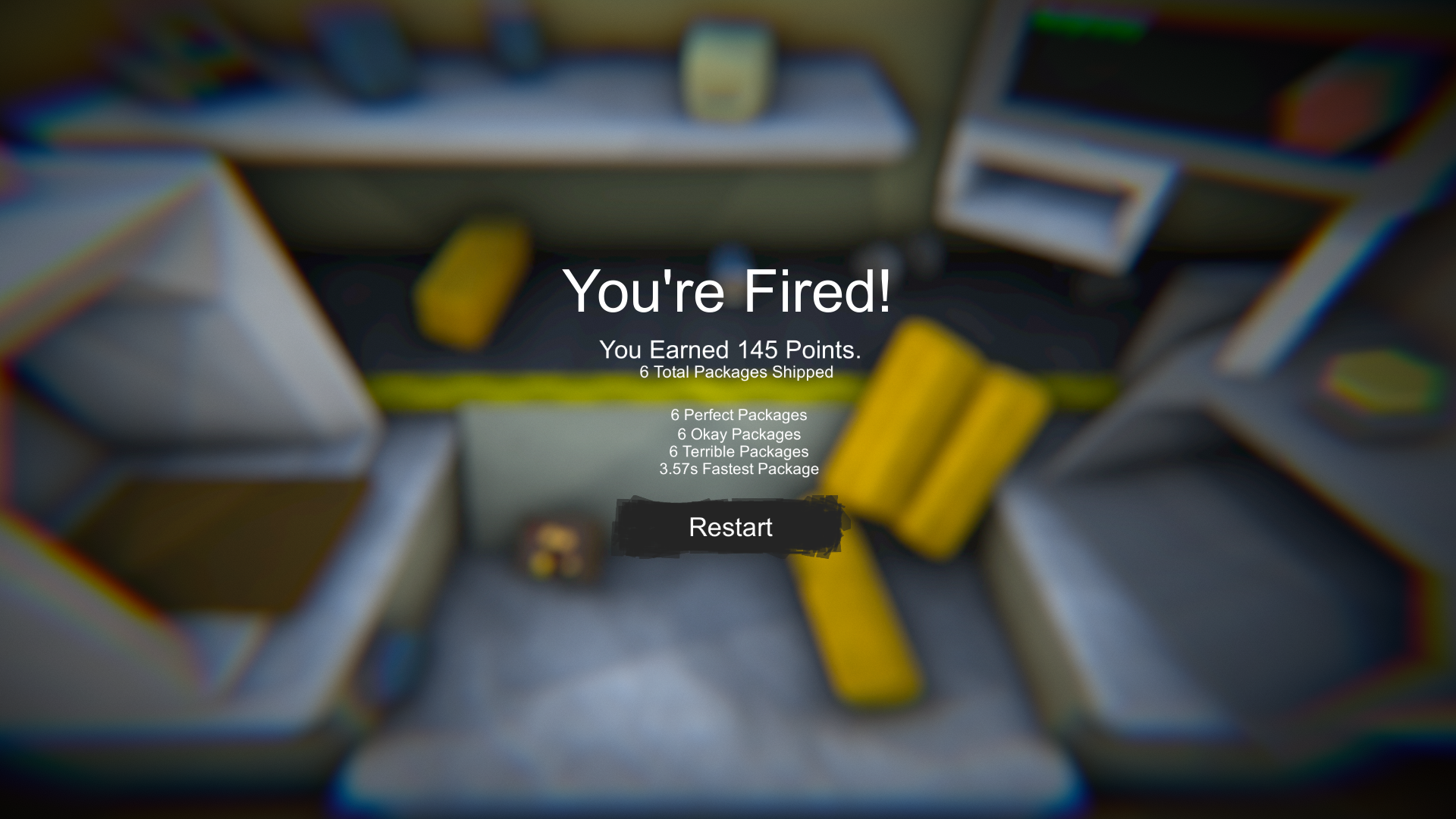
| Oct 11 04:06:19 | Parcel Problems. | ♥ 2 | Fun game! After a couple rounds I was able to score 20 packages with 2599 points. I have to say, it's definitely worth playing to the point where it starts to get more difficult, as I think the difficulty is implemented really well. In particular, the most frustrating aspect of the game is how items tend to pile up and get in your way, e.g. if you drag something off the conveyor belt by accident. And the difficulty scaling really leans into this. The box starts to fly almost all the way off the box dispenser, making it annoying if you push the button too many times, as then there will be a flat cardboard box in your way. The labels stop being convenient to pick up and instead fall down, requiring frantic grabbing. And, of course, combined with the faster movement of the conveyor belt, all these mechanics combine to make it much more likely that you grab something by accident, and make everything even harder on yourself. There is one aspect of the game that I find unclear. In particular, I'm not sure whether it is intended that some boxes are outright impossible, and that the intended strategy in that case is to simply make a bad package and move on. If so, I wonder what the best way to judge that situation is as a player. In particular, I tried a run where I just submitted nothing but empty packages... it seems I failed after 6 packages. (Incidentally, the score display on that run might have glitched out? Here's a screenshot...) 6_packages.png So it seems like I can't just always make a bad package. As such, I'm not sure if there's, like, an upper cap on the total amount of bad packages I can submit, or if I have to submit a certain ratio of good:bad packages, or what. So, in the cases where it is impossible to submit a good package on time, I'm not sure how to figure out the correct strategy. That said, I can reasonably assume that I can sometimes submit bad packages, due to the game description talking about "cutting corners," and I can reasonably assume I can't always submit bad packages, due to my empirical test and basically because of common sense. So I think it probably would be possible for me to play this game without necessarily needing elaboration on this aspect of it--I just won't be able to confirm that I'm not doing something wrong. So overall, I would say this is a really nicely polished game that has a pretty cool set of mechanics and, in particular, a well-implemented difficulty curve. | |
| Oct 11 04:33:12 | 26m 53s | Hiccups | ♥ 1 | I started off trying to do a spacebar-less run, but I failed quite early... I was unable to hit essentially anything, neither the jellyfish in the first level or the snail in the second level. I think that, fundamentally, 10 seconds is just too long, and that's for one subtle reason: Learnability. It takes me 10 seconds after booting up the game before I even know what my attack will look like. This means the very first instance of the attack is almost certainly wasted. But, more importantly, to practice the attack at all will take me another 10 seconds every time. This is an excruciatingly long time just to get one more chance to improve my skill with the attack. It is essentially like a platformer game, where the first level is around a second long (i.e. the length of the attack), and every time you die, you have to wait for a 10 second death animation. I think framing it like this makes it more obvious why it is so hard to get into the game from the perspective of a new player. Because, after playing through the game with the spacebar, I watched your video, and the hiccup mechanic honestly seemed pretty cool. When the player already knows how to use it, it is honestly interesting the kinds of strategic gameplay that it requires. It feels like a puzzle getting slotted together. So, that said, here's a couple thoughts on things that might mitigate this problem: 1. Simply have a shorter timer for the hiccups. This is in some ways a bad solution, as I do think there is some value in the 10 second timer in particular. It has a specific feel to it, that maybe you would want to keep. 2. Start the timer 5 seconds in, and have a visual indicator for the whole timer length. This makes it much faster for a new player to get into it, as they only have to wait 5 seconds for the first (wasted) hiccup instead of 10; it means that restarting a level gives you a fast timer, making it possible to quickly try a practice shot; finally, having a visual timer simply gives the player something to latch on to. With no visual indication whatsoever, 10 seconds feels like an absolute eternity--with some sort of visual indication, I think it would actually feel like less time and would also help newer players get a better sense of how they should plan their shots, I think. So, all that is to say--I like the way that the game works. I like the cool path planning and puzzle solving that a timer-based shooting mechanic introduces. It just requires, in its current state, a lot of patience to get into the game properly, and I think there are ways that it could be made easier without sacrificing the current rhythm or intrinsic feel of the game. |
| Oct 11 04:51:11 | 17m 59s | Ninja | Thief | ♥ 2 | This was a pretty fun game, once I started to get better at it! The farthest I've made it so far is losing to the third wall art to throw out. I think my favorite aspect of the game is routing. For example, first I would always take the closest chairs first. But later, I realized it would probably make my life easier if I were to take the farther chair for the first chair requirement, and then take the three closer chairs for the triple-chair requirement. Similarly, I later decided to pick up the coffee cup off the table for the second coffee requirement, as that made the coffee-and-dog requirement easier. This game also made really good use of the theme, in my opinion. There is a very direct "every 10 seconds" gameplay element, but it isn't annoying, and, crucially, it rewards you for getting better--there isn't just a 10 second deadline for every action, but you actually build up a budget of time by being faster earlier. This is what makes the routing so fun, I think. I do think a nice quality-of-life change would be to, say, draw a highlight if you can successfully pick up an item (and if you can successfully throw it out the window). I lost a couple runs to the first "pick up the person" requirement, as apparently you are only able to really pick them up by the legs. Of course, if there was such an indicator, it would make the game easier and, more importantly, it would lose some of the inherent riskiness in pushing the "pickup" button when you don't actually know whether you will succeed. So perhaps a better change would just be more forgiving hitboxes on the humans in particular. Either way, I do think this game is actually quite fun to get good at. It is very satisfying to successfully execute a route that you have learned and make real progress. I think the intrinsic difficulty in the controls, combined with their determinism--and so repeatability--make this happen. It is difficult to just pick up and start playing, but it is possible to get better at the controls, and it is satisfying to execute them well. P.S. I think it's pretty cool that this is all made in a custom engine. 😄 |
| Oct 12 00:48:49 | 19h 57m | WindBots | ♥ 1 | The graphics here are really nice and polished. This game is definitely very appealing from the get-go. I do think the controls as they currently stand are rather confusing. It seems like the spacebar both causes the character to jump, but it also starts a timer? And it seems to start a replay for the other characters? But then I wasn't able to successfully use R to run a replay for the other characters -- every time I tried, I wasn't able to run a character alongside them. For example, on the level with the two pink walls, what I wanted to do was record one character moving to the right, and then I could just play as a new character and go stand on the button. But to do this, the only sequence of inputs that seems to work is jumping around with the first character, and then pressing e.g. 2 to switch to another character, and then pressing space to reset the first character and have the motion be replayed. If I press R, then pressing 2 resets character 1 and freezes them... and then pressing space starts the recorded motion going again...? I don't know, I just wasn't able to get a good handle on the controls. But the input recording system does seem to generally work pretty well. I was able to use it quite effectively once I figured out that I could control it using the spacebar. And I really do think the graphics fit the mechanics really nicely. All this game really needs is slightly easier to understand controls, and I think it would be a really easy to pick up puzzle platformer... the graphics and the gimmick really take me back to the good old Flash game days. 😄 |
| Oct 12 02:27:33 | 1h 38m | Maudits Fantômes / Cursed Ghosts | ♥ 2 | So right when I was going to start writing my reply, I saw your comment about the new version of the game. As such, I have now played both versions. Some of my thoughts on the compo version of the game mirrored some other players, so perhaps I can give a sort of perspective on how those have changed with the new version... Perhaps the first thing I noticed in the compo game was the somewhat unintuitive movement. I would often try to move straight up or straight down, and then end up too far left or right -- in particular, I would sometimes, e.g., intend to move up-right, so I would move right and then up... and then of course I would have gone exactly two times two far to the right. As I continued to play the compo version, the strategy I ended up using for movement was essentially to only move in broad strokes... I would know, for example, that I needed to move to the bottom-left corner, so I would hold down and left, and just sort of not think about it beyond that. To narrow in on a single ghost somewhere on the map, I would tend to sort of move in this same broad pattern, and then try to get more precise as I got closer... and here I would still usually run into trouble. I do think I got somewhat better at intuiting the pattern, by the end--and I do think learning that movement pattern is kind of an interesting learning curve!--but it did remain relatively hard. In the new version of the game, moving precisely on the grid is easy. Like, it really is so much easier. If I had to guess, it has something to do with video game players being wired to think of parallel lines as the directions along which they move... the original compo game has parallel lines moving up and down, so it feels like the arrow keys should move us up and down, while in the updated game, the parallel lines are diagonal, so it feels like up and down should move us diagonally. (Also interesting: after playing the post-compo version, the compo version seems easier to control... or maybe I had already gotten better at it, who knows?) The next thing I wanted to talk about from the compo version is the memory puzzles. I think these are really quite fun. My absolute favorite thing to do in the compo game was to just relax and let my intuition tell me where to go... to try to use my vague memory of what I saw in the corner of my eye to just guess and grab a ghost. This strategy, unfortunately, failed almost universally. But it was a good time. I suppose the easy difficulty of the compo version made trying this possible. Of course, the main strategy I would use would be to track down one big group of ghosts of the same color, and to pick them off during the day phase. More particularly, I would basically try to track one of those ghosts as I was leaving the night phase, and then visually track with my eyes where one of them was walking to during the day phase. After capturing those two ghosts is when I would try to use my failed corner-of-the-eye strategy. One interesting mechanic related to that is that most of the Pac-Mans are in the corners of the map. This means that, once I have picked up a ghost, I do not need to look where I'm going to drop it off, generally--I can spend most of my visual focus tracking that one other ghost. Although, when I was moving, e.g., down-left, once I hit the bottom wall, it seemed like I needed to stop holding down in order to actually move left and get to the pink Pac-Man. Either way, this is I think why I tended not to go for orange ghosts... they would require more visual focus on the player character in order to drop them off. [continued...] |
| Oct 15 01:39:47 | 71h 12m | HURTEC | ♥ 2 | I think mashing is a very interesting mechanic in games. It is physically strenuous to pull off (to the point where it can be actually unhealthy if you're not careful!) and so in any case it gives a real sense of weight to things. A previous Ludum Dare entry I found interesting in that regard is [this one](https://ldjam.com/events/ludum-dare/48/dig-box-dig) from Ludum Dare 48. In this game, though, I find that my favorite mechanic is the mouse button mashing. It took me a while to figure out exactly what it did, and I admit that it is pretty difficult to actually pull off in the context of the game... but it is very fun, for me at least, to tap out a binary code on my mouse buttons, and more specifically, to try to do so quickly. However, I do find myself tending to focus all my attention on the binary code at the bottom of the screen. As such, my only real hope of ever hitting any enemy is to get the heat-seeking missile upgrade, as I don't tend to aim very well. This is interesting, as it means I am one way or another mandated to also mash the R key. In general I find myself mashing all three keys to get the best chance at winning. I think that's kind of neat... the game does sort of require me to mash these keys, but it doesn't do so explicitly. It is an emergent consequence of the other mechanics. Of course, I imagine the game is explicitly designed to mandate the mashing. I mean, the whole reason that the mashing feels so necessary is that I have only a ten second time limit and so I need my missiles, once I actually get done with the binary code, to do as much damage as possible. I did find myself basically never using the movement mechanics. First, because I was focused on the binary codes primarily. Second, because when I did look away from the codes, it was to attempt to aim. And third, because the movement speed of the Hurt-Mec is very slow, and the tank controls make it difficult to move as well. So, I suppose the movement mechanics are in this way the opposite of the mashing mechanics... there is nothing stopping me from using them, but everything else about the gameplay makes me very unlikely to. The other consequence of all these mechanics is that whether I actually win is somewhat random. 😅 I tend not to move out of the way of enemies, so really what determines whether I win or lose is whether they are able to shoot me before a missile that I happen to shoot wipes them out. Because: I do often fail at firing a missile; I will often get, say, 6 codes right and then mess up. It does seem like the game will give me easier codes for a bit if I keep messing up repeatedly, which is a nice little mechanic. So, basically, I would say the thematic core of this game, to me at least, is emergent incentives. The game is explicitly a mashing game, but a raw description of its mechanics could suggest that I instead, say, run around with my Mec and aim with the mouse and shoot stuff. But then, the emergent properties mean that, in practice, I don't run around, and I focus my eyes on one little part of the screen, and do nothing but mash. So it is a mashing-game inside a not-mashing-game inside a mashing-game, if you will. 😄 |
| Oct 15 02:56:57 | 1h 17m | Enter The Black | ♥ 2 | As others have said, the intro is pretty cool. It's definitely a good application of AI art -- in particular, there is no need for the different pictures to actually portray a wholly coherent location, so it's even good if they display something a little off or a little strange, as that's exactly what the hospital is supposed to be. I like the variety of mechanics in the game. The fact that picking up the screws gives you a new ability was totally unexpected, for me, and although I didn't catch on super quickly, it's cool that running makes sounds that alert enemies to your position. I played twice before reading carefully enough to learn that mechanic, and on my third playthrough I was able to win with that knowledge. The walking mechanic then actually feels pretty good. Creeping by the spiders and praying not to alert them really just seems to work very well. The degree of suspense when I did reach the end of the game was pretty intense. I certainly did not want to win at that point. I was sort of thinking that the generator switch would be the end (the lights would turn back on, permanently, and then I would be basically done), so it was a surprise and a last dash of suspense when that was not the end. I think this game makes really good use of the theme. I got so attuned to the light on/off cycle -- I could feel the limitations of my movement, and I really started to pay attention to them. In my winning run I had two really close calls where I almost got eaten by the spider (or succumbed to the darkness, I guess). That was very intense as well. The level design in this game is worth discussing, I think. First, I think that putting the map near the beginning is a pretty good move, although I totally missed it in my first playthrough. Second, I found that the knowledge of my early playthroughs was really helpful for my later ones, as it is actually pretty hard to find stuff in the map. Some of the items were also hard to spot on the background, such as the oil filter--that one I had a very hard time finding. One thing I think that made it harder is that areas that are marked as one particular area on the map are often not made of one connected room--you often have to go all the way around long hallways to get between two sections of an area. This means that it is very hard to just go from area-to-area and collect all the items in that area. But this is of course a very effective decision. This kind of navigation is so awkward that it really effects the feeling of the game--and it definitely contributes to the suspense and the horror, I think. It does get frustrating at times though. 😅 One thought I had about a small-ish change to the level design would just be to have, say, a couple different floor-tile-types or something, one for each area. That would at least make it easier to tell where each area starts and ends--I had a really hard time finding something in the storage area, for example, because I didn't really know that the right side of the map was the storage area. The number of items required to win is, I think, a reasonable balance, but it is definitely difficult to win. It is very easy to lose, and it takes a lot of time investment to get back to the same point, and each second is kind of stressful due to the ease of losing. So, if I were to have lost in my third run, I probably would not have started another one. Little note: after winning there is a "high scores" screen but it didn't seem to do anything. But yeah, overall I think this is a pretty darn effective horror game. The walking is good, the ten-second-cycles are some of the best application of the theme I've seen yet. And, the level design is contorted in a way that is extremely effective. So, good job! 😄 |
| Oct 15 03:23:14 | 26m 17s | Trick or Retreat 3.10 | ♥ 1 | This is a nice little game! So, first of all, one thing I think is really quite neat is the way that the back button impacts the story. In my short-term memory I can easily keep track of several of the diverging paths, and so I basically played the game as a sort of depth-first search, where I would still have some general idea of the endings (and the paths to reach them) that I had just played. This meant that I was really, like, reading a nonlinear story, in a way that felt really natural and let me get a very precise idea of what was going on. This is pretty cool, and I'm not sure I've really seen it before. Sure, lots of games have diverging paths, but the key mechanic is the "back" button. I mean, I guess other games have probably done that before, but I'm not sure I've ever played one. Another thing I found pretty neat was the letter that could be found. I did not go back and play the other Trick or Retreats this time, but the letter definitely was reminiscent of their stories. I think this was a really nice touch, even if its only really perceptible to people who have played the other games in the series. Overall a nice little chill game, with a well-done nonlinear story. |
| Oct 15 04:10:42 | 47m 28s | Missdemanor | ♥ 2 | The core set of mechanics in this game -- the timer and the lightning -- are really clever. I mean, as far as cursed items in video games go, this necklace is one of the best ever, as the mechanics actually feel like a trap that a powerful magic artifact would put you in! I think that's really cool. It took me a while to figure out the way that the enemies worked at first. In particular, the first time I played I actually somehow glitched to the checkpoint (?) that spawns you on the stairs to the right of the first enemy, even though there is no candle in sight. As such, I was confused, as I had never figured out how to actually get past that enemy. (At that point I restarted the game so I could figure it out properly). The other section I had trouble with was the enemy that appears at timecode 2:13 in the video. I kept trying to use the lightning, I didn't realize I could lure them away, which was obviously much easier. The red outline would flash for like half a second though, and I kept trying to hit that window, and because it seemed possible I didn't even stop to consider alternative strategies. That is, of course, mostly coming down to that section being a twist on the mechanics, requiring the player to strategize a bit to get past it. I think the only thing I would criticize is that some other sections of the game do seem rather precise, such as the first enemy encounter, which I think may have contributed to my feeling that the intended strategy was to zap that enemy. One thing I do really like is the use of collision shapes in this game. Many people have already mentioned the player head, which is great of course. I actually do have one thing to say about that, which is that the enemy hooked on the ledge is an incredible payoff for that mechanic. It relates the enemy to the player character super strongly, as now they both have this nifty head-collision mechanic. And, the enemy is in a super vulnerable spot, hanging off the ledge, holding on for dear life... and the easiest strategy there, as a player, is to kill them. This is like, really neat, I think. It really feels evil, and it's just the conflation of a couple of game mechanics that we have already been introduced to. It's great. The other thing about collision shapes I wanted to say is that I quite like the stairs. They add a good bit of precision in a way that is both pretty natural and kind of novel. Navigating stairs quickly is just a cool bit of gameplay. So overall, I think this game is just packed with cool mechanics and cool applications of those mechanics. Absolutely some of the most creative and clever game mechanics I've seen so far this Ludum Dare. |
| Oct 15 04:27:14 | 16m 32s | 10 Seconds Cycles | ♥ 1 | Really nice graphics and audio on this game. It feels good to play, and I think the graphics and the sounds contribute a lot to that. Two notes on the health pickups: one, it might be nice to make the pickup range just a tiny bit longer. Ultimately I found it wasn't that hard to pick them up, but I think the game might feel better if they were easier to pick up. Two, I think something that would be cool is making them possible to pickup for just a teensy bit of time after the phases switch--so that's it's possible to have these "got there just in the nick of time" moments right on the turnover between the phases. Sure, it would make the game slightly easier, but I think it would create some fun moments. As others have said, it is hard to see anything in the direction of the bottom of the screen. Now, this is actually kind of fun in one way -- it means that moving to the "back" of the arena gives you a strategic advantage, as it lets you see basically the whole arena. And this is kind of fun, as it means there is a direction that you always want to be moving, and it also means there is inherent risk in picking up the health pickups that are on the other side of the arena. So I do think that this mechanic could actually be a good thing, but maybe could use some tweaking to find the exact right balance. But yeah, overall, this is just a nicely polished little highscore game. By the way, my score was 10,810. 😄 |
| Oct 15 05:15:11 | 47m 57s | Village Defender | ♥ 2 | So I think I was technically able to win the game? The strategy I used was to destroy the left enemy base first, and then destroy the right enemy based using a cheese strategy where I stood right next to the nearby ledge so that I could attack the base, while the enemies would simply stand at the base and try to shoot me but miss. Unfortunately I was not able to really figure out how to effectively use the workers. I tried using the rally option several times, but it seemed like if I called all the workers to the base then my village would be destroyed as there was nobody defending it. I couldn't figure out a way to just select one worker or small group of workers and tell them to attack the enemy base. Well, so now, I tried starting a new game and immediately rallying all workers to the left base. That seemed to work that time. And then I rallied them to the right side later. Apparently my base wasn't destroyed that time, for whatever reason. I'm not sure what exactly the best strategy is with the workers. 😅 This time I guess my winning time was actually faster, so I guess rallying them as fast as possible is the way to go, maybe. I think maybe something that would help is just being able to zoom out enough to see your village and the enemy base? That way you could at least know if you were leaving it undefended or not. I guess maybe workers can be commanded by clicking them? It seems like clicking on them does something, but I can't figure out how to tell them what to do after clicking on them. But that also explains why I couldn't even try to attack the enemy base with individual workers... they were all off screen so I couldn't select them in the first place! 😄 I also encountered a lot of lag when more enemies started to spawn in. It's unfortunate, as I feel like the lag is probably the main obstacle to me really being able to engage with the rest of the mechanics. I did glance at the source code, and I have to say -- I think the navigation stuff you're doing looks pretty cool! 😄 It did actually kind of surprise me how sophisticated the workers' path planning was. It's pretty fun to see them all jumping over different platforms to get to the enemy base, and I think the map you made does a good job of showing that off. (Similarly, a lot of the UI stuff is pretty slick, both the action icons for the enemies, village, etc, and the settings menu... although I do think the settings menu should not require restarting the level to access). Like others, I did enjoy the music and the graphics. I think this game does feel pretty polished when it is running normally. So, overall, I think this game has a lot of nice visual and audio work, and has some pretty cool mechanics (pathfinding, and a combat system with a variety of viable combat strategies!), but is in its current state hindered by lag. |
| Oct 15 05:29:40 | 14m 29s | MEGACHONKER | ♥ 6 | This is a pretty good twist on the core "space shooter" genre. It's especially fun because bigger ships almost always seem like MORE POWERFUL ships, as a general rule of video games, while in this game getting bigger is added challenge rather than added power. More interestingly, I would argue that the bigger ships in this game make it more fun even though they don't make you more powerful. In particular, I think the bigger hitboxes are where this game becomes more fun, as the challenge level is higher but it is also a novel kind of challenge--most space shooters aren't about navigating with a really big hitbox (in fact, they are often about navigating with a very tiny hitbox!) I think this is very much in line with the title--"MEGACHONKER" very much sounds like something where bigger = more fun. One thing that I think feels pretty good is when you slide right under an enemy ship before it hits you and fire right at that moment. It is just satisfying in some way, as everything lines up nicely. And, of course, the more general strategy in this game is about choosing--do I want to try to destroy that enemy ship, or avoid it? And so when you make a choice to destroy the ship, and you're right on the cusp of taking damage, it is just kind of a fun little risk that pays off. So yeah, great twist on the space shooter genre, that incorporates the Ludum Dare theme nicely to boot. |
| Oct 15 05:46:56 | 17m 16s | Big Block Mode | ♥ 3 | I am certainly not very good at Tetris so I don't expect to be able to get very far in this game. But, I do find it a lot of fun to try to strategize where there are "holes," so to speak, in my current board, and to try to fill them in with my next block. It's a neat exercise, as there's also rotations to think about. I find myself often thinking of the pieces being flipped over when I will insert them... which has not worked out very well for me so far. But I have managed to clear a couple lines -- I have gotten 1485 points. I think it's neat that the line clears count even while building the block. That was somewhat unexpected, but also can lead to some interesting "big blocks." 😄 I think that really trying to strategize is where this game becomes lots of fun. Desperately trying to count columns from the left and the right, looking for matching spots, finding an opportunity for a row clear that happens to line up with the current chaos... it's fun even though I am bad at Tetris. I think that's great. |
| Oct 15 17:45:18 | 11h 58m | Neon CGTD | ♥ 1 | Great execution on a fantastic concept! Deck-building tower defense is an interesting combination, because of course in deck-builders you generally are constantly playing cards, making it difficult to have concepts like tower upgrades. Instead, in this game, you are constantly building more towers, and that's interesting because being able to easily build many many towers is tricky to balance correctly. I think the balance in this game is pretty good though! It is not too easy, despite the ability to build many towers, but it is also not too hard. That said, it does seem like the difficulty curve is that the beginning of each level is usually going to be the hardest part. I did have some levels where the ending ended up being harder, as the end had a bunch of fast enemies that were able to get past all my defenses, but every time I actually lost the game was near the beginning of a level. I think that it could be nice to change the beginning of the level just a little bit to give the player more time to play their initial cards. I often was too busy looking at the map and trying to figure out where the enemies would be coming from to really make the best use of my time. So I think I would like it if there was some way to see the map before starting the actual gameplay, or if there was some extra time for the first round of cards and an extra delay for the first round of enemies. Either way. But overall, I had a good time trying to put together a good hand. I think that there are cards that synergize well together, which is great, as that is always the fun part of a deck builder. My best strategy was using the sharps and the freezes, which went well together, I think. |
| Oct 15 18:12:18 | 27m 00s | Neon Speed Gauntlet | ♥ 1 | I really like the wall-dash mechanic in this game. I am in general a sucker for platforming moves that take a couple inputs to pull off successfully, as I think it's a lot of fun to get dynamic movement out of a precise combination of inputs--it makes those moves feel difficult, and therefore very satisfying, to pull off. I do think, for the difficult platforming sections (i.e. stage 3) I might have preferred platforming challenges that were not so strictly timing based... I found that I couldn't really appreciate the platforming in stage 3, as I was more worried about not messing up the timer. As others have said, easier ways to restart would have also helped here. Especially because, if you mess up something early in the level, you kind of know that you're doomed, but you have no way to quickly restart. That said--stages 1 and 2 are actually really fun with the time pressure. The wall jump move feels fast and satisfying, and flying through those levels with it is just fun. And I do like the platforming in stage 3. The second section of it especially feels fun, trying to dash precisely in between the lightnings. I just haven't been able to get through all of it with only 2 lives so far. I came very close... but ran out of time in the last section. |
| Oct 16 00:16:10 | 6h 03m | Dubious Arcade | ♥ 7 | Really cool game! The variety of minigames was great, and the presentation is especially solid... the way that the user interface is laid out works really well. The minigames are even physically miniature on the screen! I do think that the range in difficulty of the games is pretty high. Some of them are extremely easy, such as the sandwich game and the otter game (although the otter one is of course best on the very first playthrough, and I imagine, shines even more when in a group of players). Then one game, "rescue the diamond," is so hard that I have been unable to beat it. I started escaping to the title menu and repeatedly starting a new game just to get a couple more attempts at it, and I still haven't managed to win. 😅 But, I really do like the sheer variation in the games. Some highlights: the train one feels really good to play. The jester one plays and sounds good. The dab one is quite funny. One thing I especially like is the variety in aesthetic styles between the games... some being cartoonier, some being pixel art, and some being more photorealistic kinds of art. I do think that the random game selection could perhaps be improved. Several times I would get many duplicate games that I had already won -- I think in those cases it would be more fun to either get a duplicate of a game I had lost (or, in multiplayer, that nobody had won), or to get an entirely new game. Perhaps duplicate games could be rejected if they had already been won? (Or, at least for the easier games... one run I got three sandwich games, which were all very easy. One run I did win the needle game but then it came up again and I lost that time... so maybe duplicate games make more sense when the game chosen is one of the harder ones.) On a technical note I feel like the audio balance is a bit off. The first time I played I couldn't really hear any music, but some of the sound effects came through quite clearly. Then I realized if I turned up the volume I could hear the music reasonably well... but then some sound effects were way too loud (such as the dab sound and the boop sound). But besides that, everything feels polished and I had a good time doing a couple runs. I managed to get a high score of 9 points. 😄 |
| Oct 16 02:03:21 | 1h 47m | DiscoNinja | ♥ 1 | Great use of rhythm in this game! I have also previously tried to make a shooting-rhythm game, and I have to say, yours is much better executed than my attempt was! 😄 In particular, shooting feels really good in this game. The sound design and visual effects are basically perfect, and the animations that play when you do the different kinds of shooting are super fun as well. I like to try to mix up the two kinds of shots to get a sort of melody going. I did find that pressing Q seemed to be somewhat inconsistent. Sometimes I would take a lot of damage while I repeatedly pressed Q trying to get the breakdown going. I guess having some more visual/audio feedback for that would be good, so that it matches the polish level of the shooting mechanics. Actually, I just reread the description, and now I see that it must have been that I wasn't pressing Q on the beat. So, maybe just having an audio cue when you press it off the beat would be enough. Or maybe there already is one, and I'm just missing it 😅 But besides that, this game was just really fun to play (first 5 stars I've given this Ludum Dare, I think), even if it is more of a tech demo than a fully fleshed out product. Great job! |
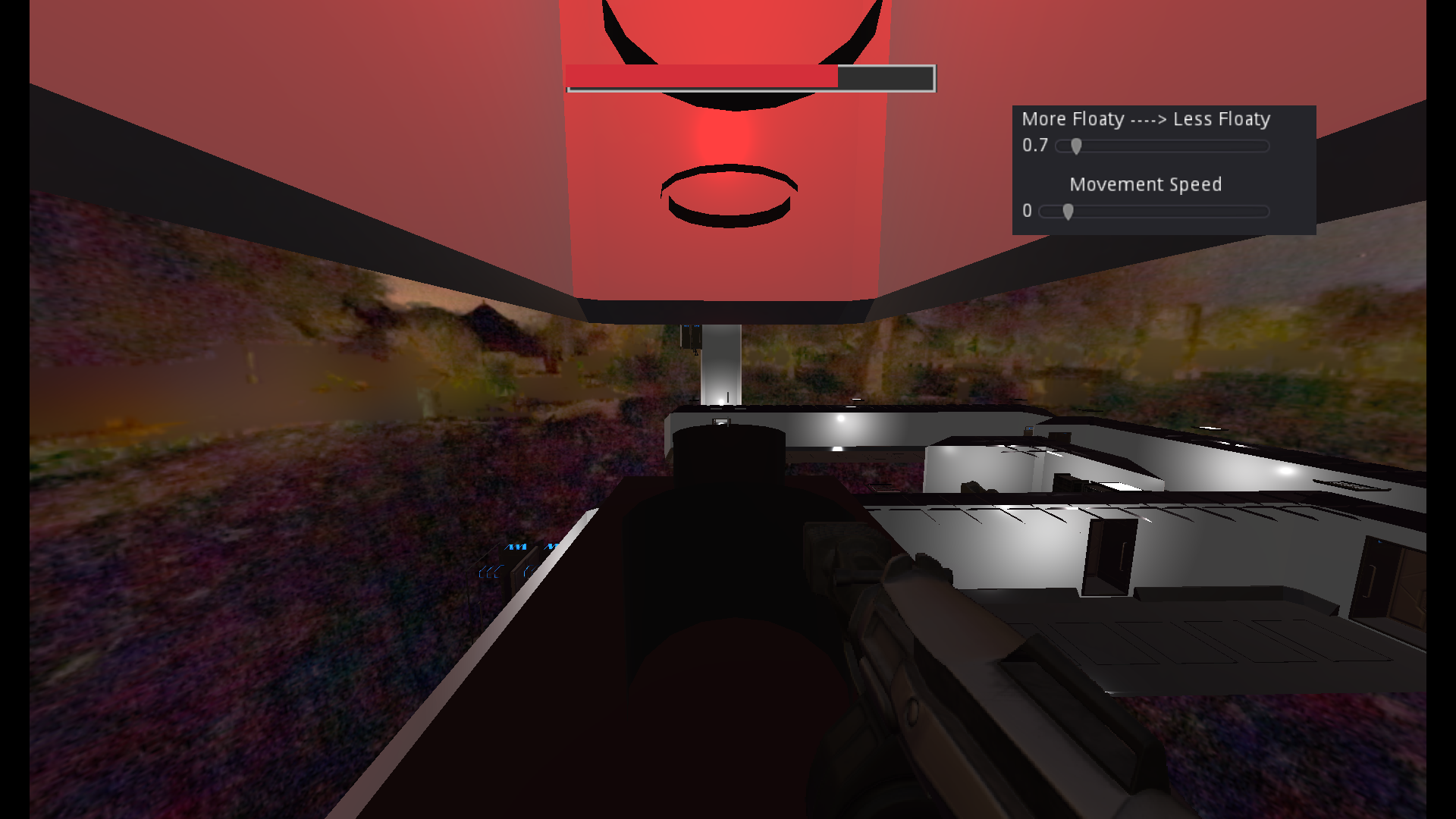
| Oct 18 01:36:40 | 47h 33m | LD51 | ♥ 3 | First, a couple boring technical notes (also, for reference, I'm playing on the Windows version): - The mouse sensitivity is really high. My mouse does have a convenient control for this, so I was able to turn it down, but an option for that would definitely be appreciated as well. - There are two sliders visible that seem to be movement options or something but I can't find any way to click them. - The pause menu is a little glitchy, seems like sometimes clicking the "resume" button doesn't work... in fact, if you do push the resume button, then to close it requires pushing "escape" a second time and pushing the "resume" button a second time. - The game seems like it might be lagging? I'm not entirely sure. I know I've had lag problems with 3D Godot problems in the past. Maybe Godot 4 will finally arrive and save us all from 3D lag problems 😅 Okay, so on to the interesting stuff. I think that the current use of the gun is pretty good, all things considered. It is interesting that the little camera objects will spawn extra turrets if you don't shoot them. This is a great mechanic. The turrets themselves are quite threatening. In particular, I like that they take three shots, and that the gun is relatively slow to shoot. This makes trying to take out turrets an interesting challenge, especially when combined with the camera objects, as then it becomes a question of which object to shoot first. It also makes sneaking past them very attractive. I think this is pretty cool. I think I managed to get through all the rooms in the game. I like the little side room with the desk. I haven't found anywhere to go from the room with the red light and all the turrets, so I think it must be the last one. I did, however, manage to glitch through the floor, which helped me confirm that I had probably seen the rest of the map: world_glitch_screenshot.png So overall I think you all did a good job constructing a set of mechanics that mesh with the narrative you laid out in your game description: I really do feel like the turrets are dangerous, and that it is worth being strategic in how I approach exploring the ship. |
| Oct 18 01:45:56 | 9m 16s | The Useless Clock Machine | ♥ 1 | This is a pretty effective game. It is of course very simple, but I think that's what makes it work so well. In particular, it reminds me of playing tic-tac-toe or some other paper-and-pencil game... the objective is both abstract in some sense but also overwhelmingly clear; there is no need for graphical flourish, as there is no story being told besides the raw game mechanics. And the thing I really like is that, although it is very easy to understand the basic concept of the game, it is actually really hard for me to wrap my head around the exact behavior of the opposing player. It seems like the arms are moving in a pretty simple pattern, but I can't really derive a counter-strategy that follows the arms... my only hope is to look for red stars that are forming and quickly click them. If I try anything else--something like, watching the arms and trying to see which stars they will be taking in the future--I tend to have a harder time and to lose more often. I think that's pretty cool. The mechanics are extremely simple but it is nonetheless not possible for me to quickly build an intuition for them. |
| Oct 18 02:03:09 | 17m 13s | Tower Boy | ♥ 1 | I quite like the idea of the three different phases. I wonder if they could be made more interesting, however -- right now I tend to almost never have coins to spend, and I only tweak my position slightly in order to get closer to some of enemy spawns, sometimes. I think an interesting twist would be to have a different minigame for each of these phases. So the first phase, there would be a minigame of some sort that let you upgrade some properties. That way, every time you reached that phase, you would be guaranteed some upgrades, as long as you did well in the minigame. And then in the second phase, there could be another minigame that let you place down multiple towers. So, the better you did in that minigame, the more copies of a tower you would have going. I think that could be a way to make the 10 second phases much more energetic and chaotic. Because I do think that splitting up normal gameplay features that would usually all be available all the time into three discrete phases is a fun concept -- but I think it could be even more fun to push it further. 😄 |
| Oct 18 02:31:38 | 28m 29s | 10 Second Boss | ♥ 2 | This was a pretty fun game! I was able to get to level 15 and kill 85 bosses. I love the variety of items available, as well as the sound effects. Also, the experience points are fun--it's fun to try to collect them all at once, which is actually also strategically useful for getting health back in a controlled fashion. The bosses and items are not particularly balanced, I think. The rocket launcher does seem to be the best weapon, with the only caveat being the dangerous self-damage effect. But it is able to kill the wizard and the red thing in 4 hits, which makes them very easy to kill. In terms of bosses, the slime is much harder than the other two. I was able to generally avoid the other two's attacks almost all of the time, while it was much harder to avoid the slime's attack. And, as discussed, the other two would die in four hits, while the slime took more. Now I actually think this balance difference made the game more interesting. I tended to think of the slimes as the real challenge, and the bosses in between as a nice calm period for farming some free experience. And then I also started to try to have some health in reserve for when the next slimes would show up. One small thing: the gun icons when you level up seem to be a little glitchy. Several times the game gave me a gun that was not the one I had pressed, and sometimes pressing them didn't seem to do anything. Of course, this ceased to be a problem once I had unlocked all of the guns. Overall, I really had a blast with this one. Good job! |
| Oct 18 02:44:00 | 12m 22s | No Man's Land | ♥ 1 | This is a fun game! I didn't really understand exactly how the gun pickup mechanics worked, or when exactly my guns would be reloaded--it seemed like it had to do with the 10 second counter--but it was fun to revel in the chaos nonetheless. I think my favorite part was the final boss fight. Just, bullet hell out of nowhere... sort of (obviously bullet dodging was part of the rest of the game, but the bullet patterns were much denser and more patterned in the boss fight). It was just a nice change on the gameplay--now I had to navigate more specifically and carefully, where before I was mostly just running in circles around all the guys. So, I had a lot of fun with that. Good job! |
| Oct 18 03:01:43 | 17m 43s | Nightfall | ♥ 1 | I love the movement scheme in this game. On the one hand, I've definitely played games before where different objects on screen are associated with different actions--seems like a standard mouse-based adventure game, right? Except in this case there's no mouse. And I think that's pretty neat. Especially because, it would be possible to say, use the left and right arrow keys for moving left and right, and then use the up arrow for doors. That would be pretty standard. But instead it's just numbers. I don't know, the simplicity of the movement scheme, but at the same time the novelty of it, is a cool combination. Another thing about the movement--it feels 3D in a disorientating way. Moving left and right through the world feels like rotating my head, either due to the environmental art or due to the lack of a character on screen, or maybe both. This is a weird feeling, because it is very much not a 3D environment, and it very much keeps going to the left and to the right rather than looping around, as an actual 3D rotation would. And of course, the precipice to the right, at the beginning, cannot be traversed just by turning my head. But it feels like it could be. I wasn't sure if the star did anything. I played a couple times to check, doesn't seem like it does. I do like the other two houses. They mesh well into the movement scheme, with the numbers repurposed for new things. The fact they both are laid out so similarly, with a door, object, and portrait, is interesting as well. It is like the way that games will reuse things to save on labor cost or because that's the only way to make the art look coherent... but in this case, the rooms are quite different even though they have the same layout. That's interesting, at least to me. So yeah, cool game as usual. 😄 |
| Oct 18 13:51:30 | 10h 49m | Polyhedron | ♥ 1 | Quite a fun little game. I love how the different kinds of key inputs are introduced over time. The first screen with all the E's is a fun introduction, and then of course the math equations are a nice twist as well. I think it is interesting that each kind of code has a different degree of readability. I would say that the letters and plain numbers are the easiest to push, the arrow keys are harder, and then the math equations are the hardest. The math equations are hard for two reason: one, decoding them to a number is harder, and two: I can't reach most of the relevant numbers from my right hand. It seems like numbers 1 and 2 are the ones not displayed through equation, and I can reach those numbers with my left hand. However, the larger numbers, which are displayed with an equation, I have to reach with my right hand. But my right hand I also have to move downwards to press the arrow keys. This makes those equations hard in two different ways. In fact, I often find myself hunt-and-pecking the large numbers, because I'm moving my right hand back and forth between the arrow keys, and I don't know how to locate numbers by feel alone while my hand is still on the arrow keys. My final score was 131... I was not trying too hard at that point. It didn't seem like the difficulty was really rising, but reading some of the other comments it sounds like the patterns eventually got longer? I think that makes sense as a difficulty change. I do think that it would be kind of cool if the game had an ending--I was somewhat expecting it to end after 100. But it also makes sense as a high score game. So overall, fun game, really great use of the keyboard (and the Ludum Dare theme). |
| Oct 18 19:56:10 | 6h 04m | Supply & Command | ♥ 2 | This was a pretty fun game! I think the mechanics you've chosen work really well together to build a cohesive world that also has interesting strategic implications. So, one thing that's interesting is that it really is reasonably easy to pickup any supply drop, as getting off the tank makes it slow down. So, often, if there was a repair kit incoming that I needed, I would just get off the tank, as there were no enemies in sight, and that would make it very easy to grab the repair kit. However, when trying to pickup resource kits when enemies were nearby, the design of the tank made this a real risk. In particular, the ladder is all the way on the back of the tank--so although it is very fast to walk off the right side and pickup a resource on the right, it is actually difficult to get back onto the tank and start using a weapon. I can't just walk left again to get back to the autocannon, but I have to go around. The variation in the two weapons is also a lot of fun. The autocannon was the most generally useful, I found, because it was both precise and fast to reload. The use of the barricades to force switching weapons was nice, however, and it also leads to the question of whether it's better to try to kill all the enemies and the barricade with one mortar shot, or if it's better to snipe all the enemies and then destroy the barricade (which is what I ended up doing). I ended up not using the special shots very much as I had sort of forgotten what the control was. As such, I do think the game could be beaten pretty easily without ever collecting any of the special ammo. I do think the special ammo is a nice addition, as it gives another possible strategy... for example, maybe I would end up needing few repairs had I used the special ammo more often. So overall, great game. All the mechanics fit together pretty well, and it was fun to play through it. And, I love the voice acting as well. It's a nice touch. 😄 |
| Oct 18 20:34:28 | 38m 18s | Cosmic Crashers | ♥ 3 | Fun game, quite difficult. I had a much better time once I read the comment about how the ammo system works. I still haven't managed to get to the boss after a couple runs, I usually lose about 4-5 minutes in. (Once I lost literally like 2 seconds before the boss spawned in). I die often to knights and to running out of power. I think one tweak that could make the game easier to get into would be to change the collected-energy display to overlay on top of the energy bar. That way, it would be a lot easier to understand the relationship between how many orbs to collect and how full the energy bar will be. I think the shield mechanics combined with the rocket projectiles are quite fun. It is very satisfying to slam rockets in to the side of the rooks. I do find it difficult to use the regular bullets effectively, as most of the enemies are difficult to kill with normal bullets without taking damage. The knights are definitely the most dangerous of the regular enemies. Silly note: the mothership approaching sound effects continue to play on the game over menu, and I can actually see the mothership spawn in at some point. The music for this game is quite fun. I especially like how it seems to get more intense a couple minutes in to the game, and that building intensity definitely follows the difficulty of the game. Either way, the music really raises the energy level. |
| Oct 18 21:05:58 | 31m 30s | Birdwatching | ♥ 2 | I am a sucker for typing games, and I think this one is a great concept as well. Expressing birdwatching through a typing game just makes sense, at least to me, and while playing it I definitely feel like somebody struggling to spit out Latin names for birds so that I can start nerding out about cool bird facts. However, during the gameplay it really seemed like my inputted letters were being dropped, like, way more often than I would expect, given that my keyboard tends to work generally pretty well normally (for example, I typed almost all of this sentence very quickly and without typos). So, I suspected that perhaps the game was only allowing me to enter a single letter per frame, and from a cursory inspection of the source code it seems like this is true. Now, I'm not entirely sure if I personally can actually type more than 1 letters per frame, so maybe this is all a red herring... but I do think it would be worth changing it. If a player can type two letters in one frame, then the game should definitely let them. (From what I can tell, this is what Unity's Input.inputString is for. But, I don't know for sure as I'm not a Unity user 😅 ) I do think that rejecting the whole string when the user messes up is actually kind of fun. It is really hard, but I think if the input system was patched as I described, it would be less annoying. One other tweak that would improve it: tell the user which character was wrong when they mess up. If that was added, I think I would actually really enjoy a typing game where I had to be perfect for the whole string. Overall, I really do love the concept and I had a good time trying to maximize my bird facts, even if I had to try to type very carefully to have the best hope of winning. |
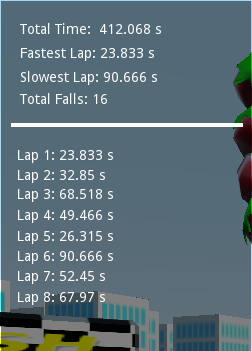
| Oct 18 23:40:01 | 2h 34m | Motor Dime | ♥ 1 | This is a neat little racing game. The "stopping on a dime" mechanic has some fun consequences. I think my favorite is that doing a jump with the ramp lets you avoid the stops altogether. The first time I used the ramp I did not know about the stopping mechanic, but I did crash, so I thought the ramp was just a recipe for crashing into the wall. But later, when I started to try jumping off the ramp without crashing, it was a lot of fun, and part of the fun was that I still crashed a couple times. (Also, one time I ended up in the middle section, and I think the lap wasn't counted that time. That does make sense, although I don't know if there's any good way to signal to the player that they are not making progress on their lap.) I think the conduits have an interesting risk/reward tradeoff. In particular, I often crashed into a conduit when trying to use it to beat the timer. This is a fun bit of irony, as in an attempt to avoid being thrown off my bike, I am often thrown off my bike nonetheless. One weird thing is that many many times I ended up like a meter away from a conduit when the timer expired. This often felt annoying because it seemed like I was going to make it to the conduit right on time, and I'm not sure if I ever did. I think the problem is that, it is difficult to give the player any leeway here, because the game only really will make sense if the stopping occurs in a very predictable timeframe... e.g. if the game were to give me an extra couple of frames to reach the conduit, it may be the case that I wouldn't be able to ever predict when the stopping would actually occur. That said, I do appreciate the leeway that the conduits give you as you're leaving them. That was basically the only way I was able to effectively use them... by brushing past them slightly before the timer expired, allowing me to keep going. Also, I think it could be worth pausing the timer whenever the player is off the bike. It seemed like it often took me about 10 seconds to get back onto the bike, meaning that I had to delay my acceleration, and then often it took another 10 seconds to turn around, meaning I had to delay the acceleration further. If the timer was paused, then the player would kind of get a free cycle every time they flew off the bike, and I think that would probably be fair. But, overall, it was fun to try to wrestle with these mechanics, and to see the silly ragdoll physics when something went wrong. Here are my times from the second playthrough I did: Scores.png Also, one note about a bug: One time when I pushed "play again" and then started the game, the camera did not change to the player perspective but seemed to remain on the menu (?) perspective. |
| Oct 19 00:08:24 | 28m 23s | Le Petit Jardin | ♥ 3 | Wow, this is such a nice entry. It looks incredible, with a very complete little world; I particularly think it's cool how some of the objects have bigger pixels, but everything still looks coherent and, simply, good. Day/night cycles are always fun. I always love the warm colors of the sunset in games. I love how tactile all the tools feel. I think that two factors contribute to that: everything is mouse controlled, and you can only hold one thing at a time. Or, to put it a different way: this game could be translated to VR and the controls would be basically the same. (Basically, I was thinking this would be a good VR game while playing it. 😄 ) The humming is also a very nice touch. Overall this is probably the coziest entry I've played yet. Very good work! |
| Oct 21 19:20:34 | 67h 12m | RED RINK | ♥ 1 | Very cool sports game. I love how energetic everything feels--the music is really great, and then it really is a rush to knock your enemies out before they can knock you out. The bomb puck is a fun mechanic, as it requires either being more careful when trying to score a shot, or to just go for it right when the timer is about to expire. I did find it somewhat difficult to control whenever all of my players were off camera. For example, it would be difficult to tell whether they were all knocked out, or when I should be swinging my weapon, as I couldn't see the enemy players that were nearby either. Also, I think that the bomb timer could perhaps be tweaked--I often would be confused exactly how much time was remaining, as the very top of the bomb timer is harder to see than the rest of it. Once I really started paying attention that the timer was the whole outline around the sprite, it was easier to keep track of, but I do think it could still be easier to see. But overall this was a fun game with incredible art, music, and polish. Great job! |