Foon → Ludum Dare Explorer → LD38 → Feedback comment stats → Lennart Jansson
Feedback comments for LD38
Lennart Jansson's games and stats for all events →
| Timestamp | Since previous | Game | Lennart Jansson's comment | |
|---|---|---|---|---|
| May 2 05:00:11 | PiP: A multi-layered puzzle game | ♥ 4 | Comment 1/ Several cool ideas here! Some things I particularly liked: - The sprite artwork is cute - Your main game logo and title screen are also cute, and fit the rest of the aesthetic well. - Confirmation on the restart screen. Conventionally this kind of screen is bound to the Escape key, but it’s nice to have extra confirmation around dangerous actions like this I think it's slightly unfortunate you didn't get a chance to spend more time on level design, because even with the small number of distinct puzzle mechanics here it ought to be possible to develop a rather rich set of puzzles. That is to say, if you were to spend more time developing this game, the best place to focus would not be on additional mechanics (like rotating blocks or monsters), but rather a deeper exploration of mechanics that already exist. Some ideas that spring to mind that weren't already explored in your four levels: - More complex puzzles involving basic block moving. You already have solid blocks, 4-way movable blocks and 2-way movable blocks in both orientations — that's more than enough for some pretty hard sokoban puzzles. - More puzzles involving blocks and switches that control lasers, even without inception-style subpuzzles: - Puzzles requiring you to shuffle blocks back and forth between various areas of the level - Lasers that gate significant areas of the level - Complex gating with lasers that cross each other, or pass through multiple rooms - Lasers with movable sources - And then, of course, exploration of the "block entering" subpuzzle mechanic: - Puzzles that require you to re-enter a block multiple times to change some internal state - Puzzles with more than one subpuzzle block - Puzzles with deeply nested subpuzzles, two or more layers thick - Subpuzzles, that when solved, change the directions in which the outer block can be moved, or change the direction a laser is fired | |
| May 2 08:34:37 | 3h 34m | Puchi Pooches | ♥ 4 | Really delightful game! A few things I particularly liked: - The sprites are crisp, clear, and appealing. Great animations -- I particularly like the enemy walk animation and the explosions. - Sound FX were simple but did the trick - Nice touch to list the controls on the first screen, and the directions when in the game levels were also very clear. From the first moments opening up the game, I never felt lost. - Good job with the level design — the first level functioned well as a tutorial, and the remaining levels had a fair difficulty ramp until the end The gameplay was generally very fun. The trick I discovered for effectively killing enemies was to walk near them, drop a bomb, then walk or jetback off into space away to avoid the splash damage. This reduced the possibility of messing up my aim and dying in silly ways. However, I ended up clearing all of the later levels with more enemies with more or less the same pattern: 1. Kill all the enemies, ignoring the chocolate 2. Then go back and collect the chocolate, without pressure So the stress contour of a level for me was always high stress at the very beginning of a level, decaying rapidly as I killed the first few enemies, then reaching a sustained low as I transitioned into the chocolate-collecting phase. Of course, it’s completely up to you what kind of contour and narrative you want to provide for players with each level, but the game will provide greater interest if there’s more variety here (especially if you eventually have more levels). Another way of thinking out it: your game features two objectives, but the player can always just ignore one and never needs to focus on both at the same time. As an extension to the gameplay that you might explore later, I think might be neat to consider ways of forcing players to be considering both objectives at once, as a way to reward more complex decision making and prioritization. Perhaps: - An portal that continually spawns enemies, once every few seconds? - If this leads to enemies that always get trapped on the contiguous piece of land surrounding a portal, then… spawn an enemy somewhere arbitrary every few seconds? - Unkillable enemies? Force the player to use the bombs as a zoning/world-manipulation tool rather than just as a weapon for killing. Or, simply reward clever movement around walls that gets enemies stuck on the other side. - At higher difficultly levels… enemies that can fly across gaps? Enemies that can hop over walls? Just some possibly fun ideas to turn over if you work on the game some more :) A few more thoughts about areas that might want fine tuning: - I played with keyboard and mouse. I felt like the direction bombs travel when aiming with the mouse is often unexpected — possibly this is due to the y-axis being squished due to the isometric perspective not being corrected in the mouse vector? Aiming was not impossible, it just was slightly more annoying and difficult that probably you intended. - I had a lot of trouble with bombs bouncing off walls when trying to land them on ledges, I think mostly for the above reason. Once I corrected my aim, it was usually not to difficult to hone in on the button hold time to produce the correct velocity. - The music didn’t seem to fit the rest of the bright aesthetic of the game’s visuals. - The jetpack animation is subtle and hard to notice, which makes it sometimes difficult to tell whether you’re flying or not. (Granted, this is very minor) But overall, very well done! The gameplay is fun and the art is super delightful. |
| May 3 07:31:23 | 22h 56m | Protect | ♥ 3 | Yay it's a rhythm game, I played through a few times and put some numbers on the leaderboard :D Nicely done with the original music! Producing decent-sounding music is quite difficult in a weekend so it's cool to see a game that focuses heavily on that aspect. The track you've composed is long and interesting enough to be fun for multiple play-throughs of the game. Other things I particularly liked: - The note patterns and arrangements vary between different sections the same way the synths provided varied timbres in different sections of the musical track. This felt good to experience - The leaderboard is a nice touch - Animations that are subtle but effective -- I like the screen shake. It's really important to give the player immediate feedback about what's happening in the game, and there's no ambiguity about when you're messing up :) Most of my suggestions for improvement will be along the lines of this last point, because there's a bit more you could do to make sure players have a successful playing experience from their very first time opening up the game. - Aside from the rather cryptic "Use arrow keys to defend!", there is no instruction to a player or indication about exactly *how* to defend with the arrow keys -- I think the mental mapping between "a square approaching from one side" and "I should press that key when it overlaps the square ring" is not as obvious as you think it is. For example, it'd be reasonable to guess at first that you as a player need to shoot the squares, or interact with them in some other way. - This is exacerbated by the fact that the player is punished immediately for experimentally pressing keys by suffering a score deduction. This feels unfriendly at first. - Once you figure out it's a DDR-like rhythm game, it's still ambiguous where exactly the hit targets are. Adjacent outside the ring? Inside the ring? On top of the blue dot? - The very first non-trivial rhythmic pattern the player has to produce (the syncopated kick drum + hat pattern) is also one of most difficult ones to read, due to the syncopation. Straight eighth notes are easy by comparison. Here are some possible fixes: - Show the hit targets as four square outlines on top of the ring, where notes should be when you press the key. This eliminates positional ambiguity - Light up the outlines when the corresponding key is pressed, to reinforce the correct mental model of how to play the game much faster - Make mistakes trigger score deductions only in Hard mode - I totally get that you want to discourage mashing. You're already scoring by timing accuracy -- I think you might be able to sufficiently discourage mashing by just making the hit window larger and giving very low scores for keypresses that are way off - Give the player some easier note patterns first, before making them produce the more complex syncopated rhythm Aside from that, the core gameplay is good! If you're looking for additional features, I think taking the "space defense" metaphor further might be interesting to explore. Equating the notes/steps with enemy ships, what kind of gameplay features would you expect to find in a space defense action game? Notes that move at different speeds from other notes? Notes that require multiple taps to destroy? There are tons of possibilities. |
| May 3 07:41:21 | 9m 58s | You Are World. | ♥ 1 | I'm not sure I have anything productive to contribute, but just wanted to note that this was an intriguing and novel experience. But first, beautiful aesthetic. The music combined with everything in the visual style seemed carefully and thoughtfully crafted (although the swirls in the background might have been a little bit kitsch). I, too, kind of assembled hexes randomly without really considering height or heat or volcanos or water and I progressed and finished the game anyways. If this was meant to give the player tradeoffs to make, I didn't experience that. I kind of wish it lasted longer. I saw all the giant pieces out past the largest orbit and got excited that I was going to have a Katamari Damacy experience where my turtle would grow larger and faster and my hex world would become huge and compex. But I accept that that may not be the narrative you were intending to guide the player along. |
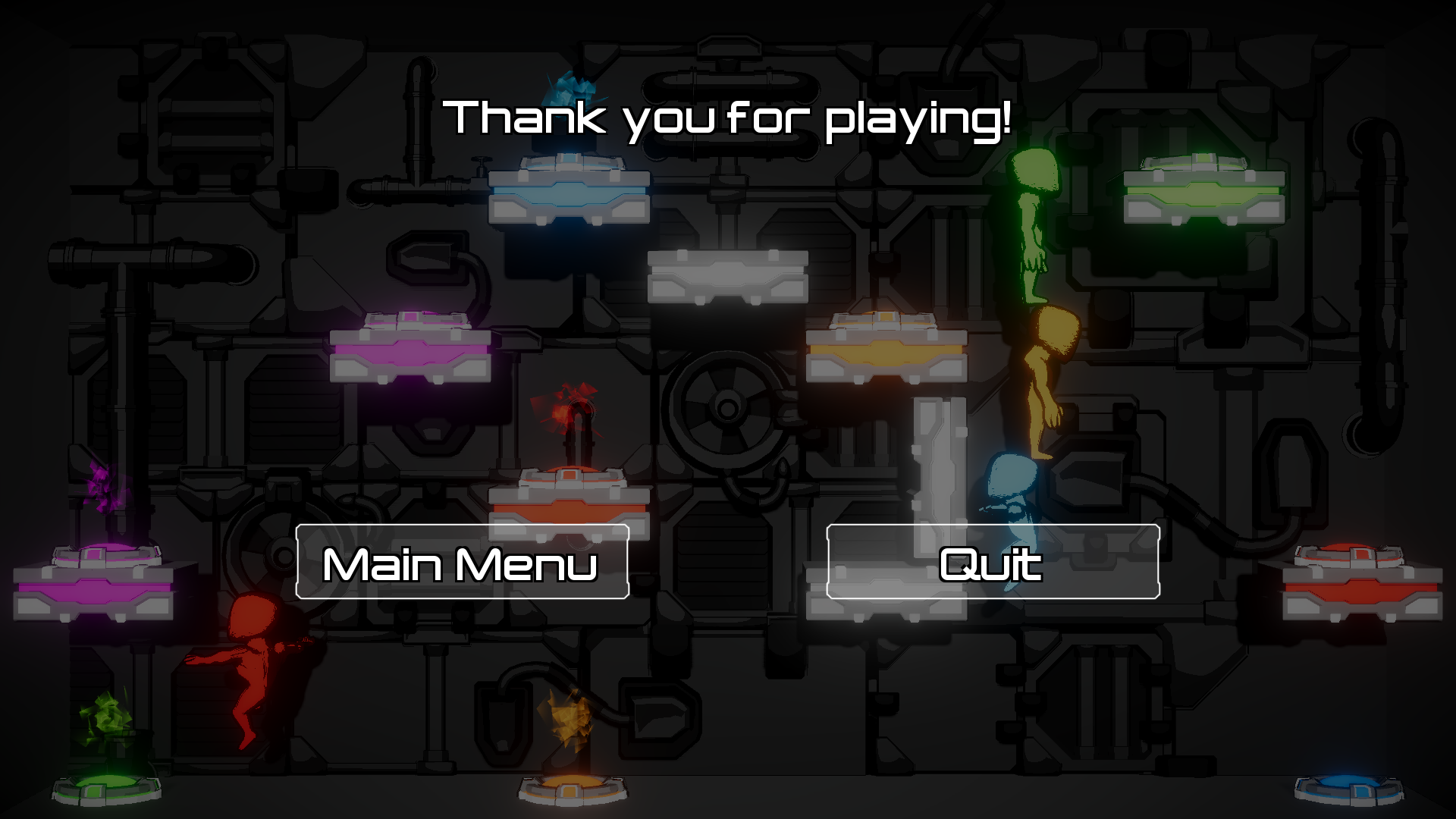
| May 4 05:59:49 | 22h 18m | Yourselves | ♥ 0 | Excellent game and really fun to play through! The full run took me around 40 or 45 minutes. Screenshot 2017-05-03 22.09.51.png I appreciate the careful design of the levels -- the difficulty ramp was good and each level required new approaches and ideas to solve, with each element being deliberately placed. As such, each of the harder levels was very satisfying to complete and never felt like busywork. A common failure mode in puzzle games (that this game thankfully did not fall into) is to construct "filler" levels that do not present any additional difficulty or require additional insights over previous levels -- these are obviously not nearly as fun to play through :) The graphics are outstanding as well. If you did the character modelling, rigging, animation, and shader development all during the weekend I'm very impressed -- even if not, the game's visuals also seemed very carefully designed. I liked that the platforms and every game object significant to the gameplay had high contrast against the background. The background was detailed and added a lot of flavor but was never distracting. It's also a neat touch to have the background reinforce the grid used for positioning all the other objects, which actually helps one figure out which platforms one can jump on, which require another object to step on, etc. I'm not sure I have anything too constructive to tell you, beyond what you probably already know: - I turned off my sound after a few levels because the footstep clinking got on my nerves - The platformer collision detection and behavior was occasionally frustrating. I occasionally felt I should have successfully made a jump but instead fell just short. - Why was there a crouch action? I didn't find any use for it since it prevents you from walking. > one way to possibly get around this would be to add a restart that only restarts to the most recently spawned color. I sort of felt the same way for a while during the middle of my playthrough. I kept bonking my head on a ceiling trying to cross a gap in the second-to-last level as the green character and kept getting stuck in the pit, wishing I could undo just that layer without having to replay the blue and orange layers. But I think by the end of the game I changed my mind. The trick is to not waste too much time on the earlier layers, and retry immediately if there's a mistake. That is, go fast and iterate in short cycles. |
| May 4 06:32:27 | 32m 38s | Snowday | ♥ 2 | Really beautiful little experience. All the elements work so well in reinforcing the scene's quiet meditative character and the feeling of being dwarfed by one's surroundings. Some little details I particularly liked: - Excellent attention to detail in the sound design -- love how the footsteps change when walking on the docks - The subtle film grain, which gives everything a kind of vintage warmth - The camera pan out over the water - I particularly like the sprites for the large evergreen trees Out of curiosity (these are not meant as critiques): - Did you consider a parallax scroll effect on the trees and mountains in the far background? If yes, what led you to decide to keep all of the background elements fixed? - Are you rendering with the GPU or the CPU? I'm not confident I'm getting a consistent 60 fps. (Well, perhaps I am. I didn't investigate too deeply...) On my monitor on my machine, I notice a flickering effect on edges of high contrast pixels, while walking but more so while jumping forward. I wonder if it's just my box, or a consistent behavior of the game -- if the latter, I wonder what can be done to mitigate the flicker? Of course, I only noticed this because of how serene the rest of the visuals are :) I suppose there was one other thing that broke immersion a little bit, and that was that when stepping away from the edge of the either dock and walking back toward solid land after staring out over the water a while, the camera has to pan back to center on the player character, and I thought it snapped back uncharacteristically fast. |